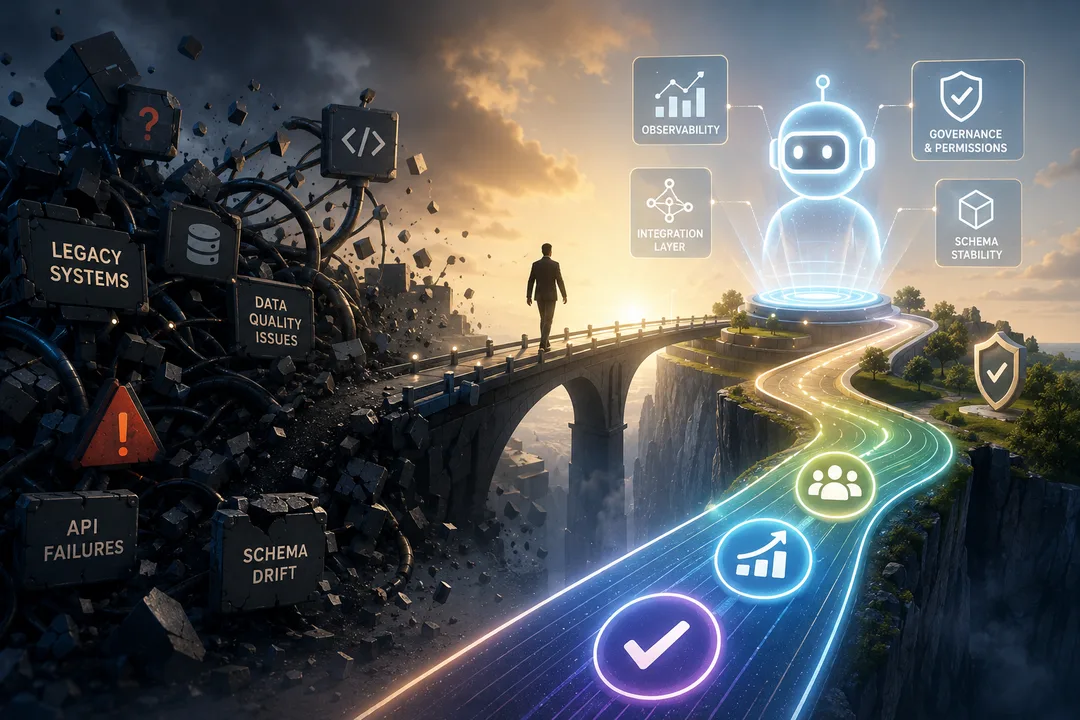
Most demos of multi-agent systems look decisive. A planner wakes a researcher, the researcher wakes a coder, the coder wakes a critic, and somewhere a slide says “autonomous.” If you have sat through enough of those demos as a CTO or VP Eng, you have also learned the quieter truth: the hard part is rarely getting agents to talk. The hard part is AI agent orchestration, the missing org chart, who owns which agent, which tools they may touch, what budget they burn, when a human must intervene, and how you prove any of it worked, without ending up with a spaghetti tool graph that only the original author understands.
That last clause is the whole problem. Orchestration fails the way certain codebases fail: one person (or one weekend prototype) owns every edge, every retry, every secret. Everyone else hears “almost ready for production.” Appeasement feels cheaper than a redesign. Then the bill arrives.
Industry numbers are catching up to that bill. Gartner predicts that over 40% of agentic AI projects will be canceled by the end of 2027 “due to escalating costs, unclear business value or inadequate risk controls.” Anushree Verma put the diagnosis bluntly: “Most agentic AI projects right now are early stage experiments or proof of concepts that are mostly driven by hype and are often misapplied.” MIT’s NANDA State of AI in Business 2025 report (the so-called GenAI Divide) found that despite $30 to $40 billion of enterprise GenAI spend, “95% of organizations are getting zero return,” with only about 5% of integrated pilots extracting substantial value, as Fortune summarized. If your agent program is mostly slides and shared service accounts, you are volunteering for that 40% cohort.
The pattern I have watched more than once
I am not going to pretend orchestration is a research hobby. It is an ownership and incentives problem wearing an LLM costume.
Here is the version that keeps showing up in enterprise pilots. A small team wires three or four agents to a pile of tools (Slack, Jira, Salesforce, an internal search index, maybe a shell runner “just for the hackathon”). No named owner per tool. No contract for returns, mutations, or who pays when it loops. Unbounded retries because “the model sometimes needs another try.” Context concatenated forever. A shared service account because OAuth per agent seemed heavy. Escalation is a Slack ping nobody is on-call for. Evals live in a demo-day spreadsheet.
It works in the room. It fails when ticket volume arrives, when security asks who approved a CRM write, or when finance notices a four-figure overnight “research” run that never terminated.
Watch this first if you want the product-leader framing for agentic workflows:
Ng’s point that stuck with me is that agentic systems are iterative tool-using loops with stop conditions, which belongs in the operating model long before any framework install.
What AI agent orchestration actually is
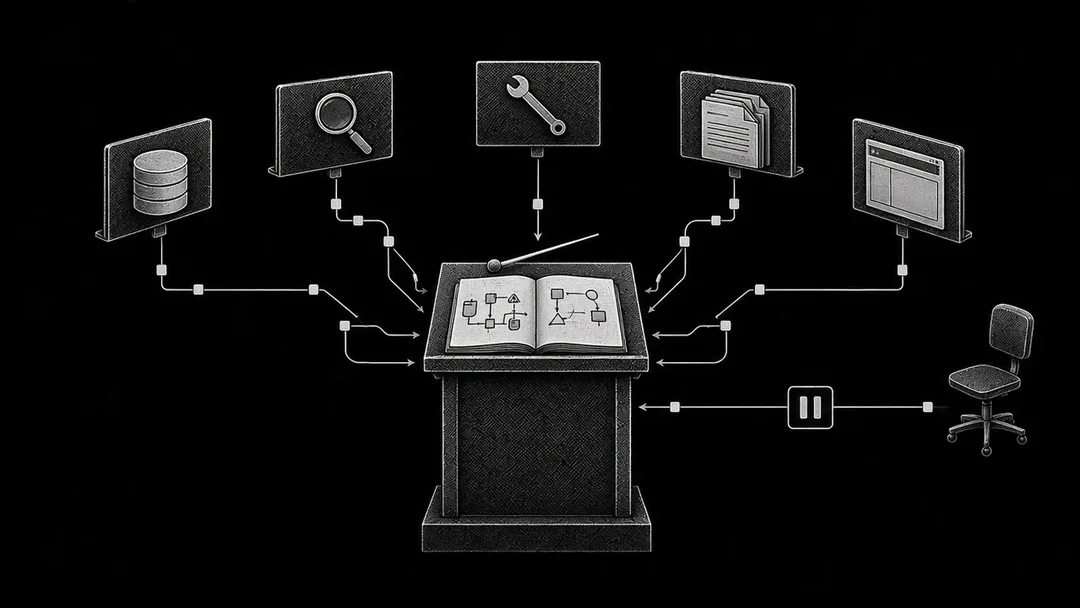
AI agent orchestration is the runtime and design discipline that decides, for each user or system request: which agents participate, in what order or topology, with which tools and permissions, under which stop conditions and cost caps, and with which human checkpoints, traces, and evaluations. It is workflow design plus runtime policy. Connecting more agents without that discipline is a chat room with API keys.
Anthropic’s December 2024 engineering note Building effective agents draws a useful line that still shapes how I brief executives: “Workflows are systems where LLMs and tools are orchestrated through predefined code paths. Agents, on the other hand, are systems where LLMs dynamically direct their own processes and tool usage, maintaining control over how they accomplish tasks.” Their headline finding matches what I have seen in delivery: “Consistently, the most successful implementations weren’t using complex frameworks or specialized libraries. Instead, they were building with simple, composable patterns.”
Failure modes with names and numbers
Berkeley’s MAST paper (Why Do Multi-Agent LLM Systems Fail?, arXiv:2503.13657) annotated 1,600+ traces across seven popular multi-agent frameworks and found empirical failure rates from 41% to 86.7% on those systems. They cluster 14 failure modes into three buckets I now use in design reviews: system design issues, inter-agent misalignment, and task verification. Step repetition alone showed up in about 15.7% of their annotated traces. Incomplete or incorrect verification is common even when a “reviewer” agent exists, because those reviewers often check that code compiles while missing whether the product actually works.
Cognition’s Walden Yan argued the reliability case from the builders of Devin in Don’t Build Multi-Agents (June 2025): “Actions carry implicit decisions, and conflicting decisions carry bad results.” His Flappy Bird example is the same failure I see in enterprise CRM agents: two specialists invent incompatible assumptions, then a third agent is left to reconcile the mess. Yan’s default prescription is a single-threaded linear agent with continuous context, and extreme caution about parallel writers.
Sierra’s τ-bench makes the reliability gap measurable for user-facing agents. Even a strong GPT-4o function-calling agent “drops to ~25% on pass^8 in τ-retail,” roughly a 60% relative drop from its pass^1 score. Passing once is a demo. Passing eight times with lexical variation is closer to what a contact center expects.
Then there is cost. Anthropic’s June 2025 post on how they built their multi-agent research system is unusually honest about burn rate: “agents typically use about 4x more tokens than chat interactions, and multi-agent systems use about 15x more tokens than chats.” Token usage alone explained 80% of variance on their BrowseComp analysis. Multi-agent can win on parallel research; it can also empty the wallet. The OWASP AI Agent Security Cheat Sheet names the failure mode directly as Denial of Wallet (unbounded loops) and “Excessive Autonomy: Agents taking high-impact actions without appropriate human oversight.”
Put those sources next to a typical pilot and the spaghetti graph stops looking clever. Unowned tools, uncapped retries, shared god-tokens, context bloat, Slack “escalation,” and missing traces are how you manufacture MAST failures on purpose.
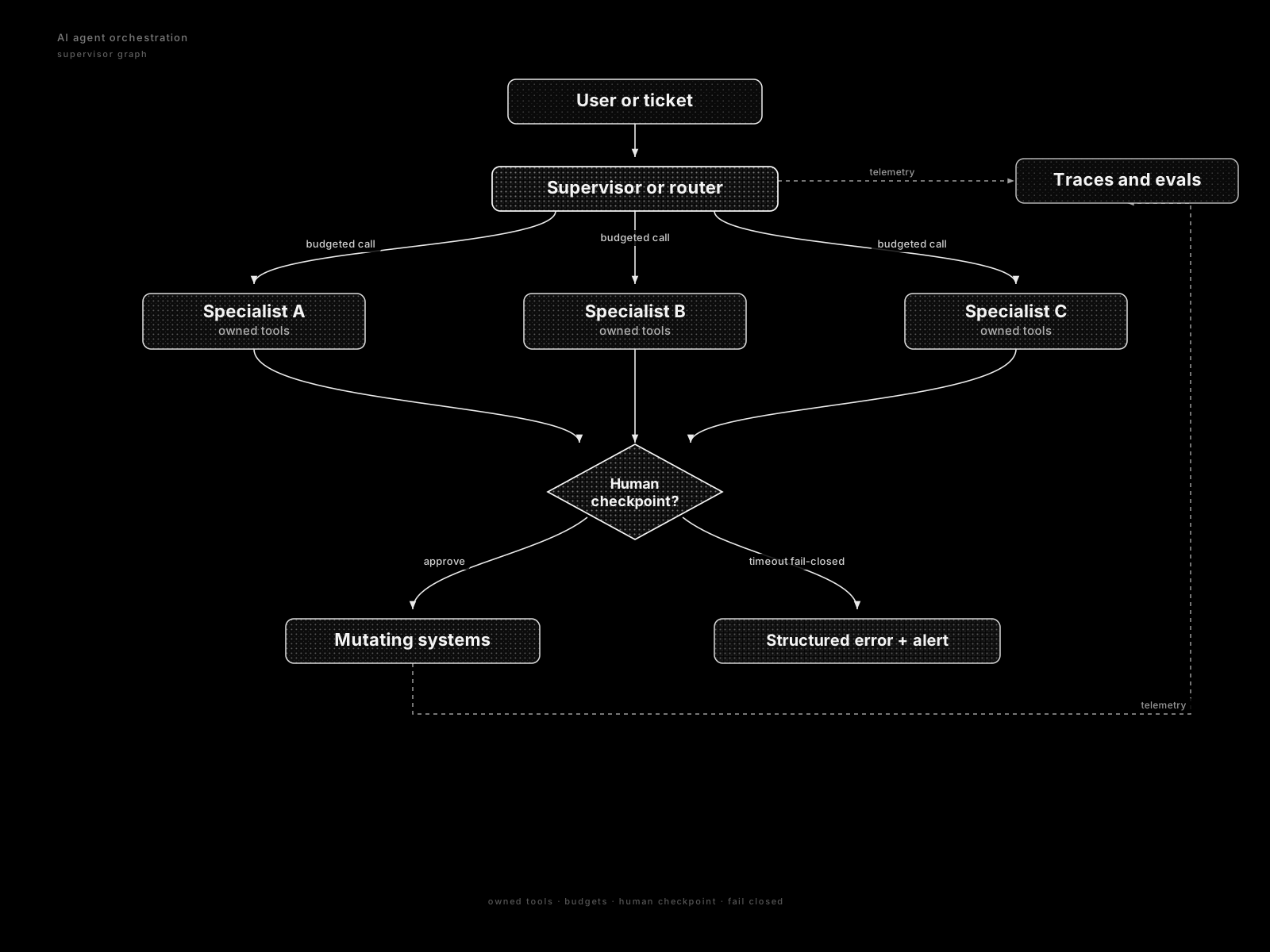
A concrete way out: design the graph like you design a team
I take a side here, because fence-sitting is how spaghetti wins. For anything that can mutate enterprise systems (refunds, provisioning, CRM writes, production changes), prefer a supervisor or strict router with owned specialist agents and strict tool contracts. Free-form multi-agent chat is fine in sandboxes. It makes a poor default when you need auditability and a clear blast radius.
Anthropic’s own research system uses an orchestrator-worker pattern for parallel research, and they are explicit that coding and other tightly coupled domains are a weak fit today: “most coding tasks involve fewer truly parallelizable tasks than research, and LLM agents are not yet great at coordinating and delegating to other agents in real time.” That sentence should be taped above every “let’s spawn ten coding agents” whiteboard.
Recommendation framework I actually use
- Topology on purpose. Supervisor/subagents (main agent calls specialists as tools) when you need an audit trail. Handoffs when latency matters and domains are clean (OpenAI’s Agents SDK models handoffs as tools such as transfer_to_refund_agent, with optional input filters so the next agent does not inherit every secret in history). Single agent with a small tool set when you cannot name why a second agent exists. LangChain/LangGraph remain useful for durable state and interrupts; skip unmaintained helper packages and prefer current subagent patterns.
- Tool ownership and contracts. For each tool: owning team, schema, idempotency, side effects, rate limits, auth scope, kill switch. Agents should not scavenge a mega-registry of seventy undocumented functions.
- Budgets per run, enforced in the orchestrator. Max model calls, tool calls, tokens, dollars, wall-clock. Hit a ceiling, fail closed with a structured error a human can retry. Log the kill. Celebrate the kill. A cheap failure beats a silent burn (and beats Denial of Wallet).
- Human-in-the-loop as a product surface. Name the irreversible actions. Bind approval to the exact tool call (OWASP’s language: separate decision from execution, short-lived authorization, fail closed). If your HITL is “someone might notice the Slack thread,” you have theater.
- Observability and evals before the second agent. Traces for every run. Golden tasks. Regression sets. Measure task success, tool error rate, escalation rate, cost per successful run, latency. Sierra’s pass^k thinking is the right reliability instinct even if you are not running τ-bench yet.
For a builder-level discussion of where multi-agent helps versus where teams are still early, watch -
Pair it with The Future of AI Agents if you want the follow-on framing for platform teams.-
Frameworks without the brochure voice
Need | Starting point | Watch-out |
|---|---|---|
Durable state, interrupts, supervisor/subagents | LangGraph / LangChain agent patterns | Skip unmaintained langgraph-supervisor; follow current subagent docs |
Role/task crews with task-level HITL | CrewAI | Console approval makes a weak enterprise approval UX |
Conversation-of-agents experiments | AutoGen / AgentChat | Blocking user-proxy during run is fragile for durable workflows |
Handoffs, guardrails, first-party tracing | OpenAI Agents SDK | Filter handoff history; do not leak tool secrets across specialists |
Parallel research at high task value | Anthropic-style orchestrator-workers | Expect ~15x chat token burn; require economic justification |
A framework alone never substitutes for the orchestration strategy. Ownership, budgets, checkpoints, and evals still have to be designed.
The appeasement trap, agent edition
Companies delay confronting spaghetti graphs for the same reason they delay confronting bus-factor-one engineers: short-term calm feels valuable, and the person who insists on redesign looks difficult. Every week adds another unowned tool, another uncapped retry, another shared credential. When the first serious incident lands (wrong CRM update, runaway bill, compliance finding), you discover you cannot “just turn it off,” because six workflows now depend on the tangle.
Chip away instead. Pull mutating tools behind owned services. Put budgets on every run. Insert one real human checkpoint on the scariest edge. Delete agents that do not earn their keep. Shrink the graph until a departure (of a person or a model vendor) is painful but survivable.
That is orchestration with a spine. Everything else is a demo that learned to say “production.”
FAQ
What is AI agent orchestration?
AI agent orchestration is how you control multi-agent systems in production: which agents run, which tools and permissions they get, what stop conditions and cost caps apply, when humans must approve, and how runs are traced and evaluated. It is workflow design plus runtime policy.
How is AI agent orchestration different from a single agent with tools?
A single agent with a small, owned tool set is often enough. Add orchestration when distinct domains or permissions justify multiple agents, and when you need routing, handoffs, or human checkpoints. If you cannot name why a second agent exists, you probably do not need it.
Should we use a supervisor pattern or free-form multi-agent chat?
For systems that write to business systems, start with a supervisor or strict router and specialists behind tool contracts. Free-form multi-agent conversation is useful for exploration. It makes a weak default when you need auditability, budgets, and clear blast radius. Cognition’s context-sharing principles and Anthropic’s “coding is a weak fit for multi-agent today” guidance both point that way.
Where do human-in-the-loop AI agents fit?
On irreversible or high-cost actions: money movement, external communications, production changes, compliance-sensitive outputs. Implement a durable pause with an owner, SLA, and safe timeout. OWASP’s agent cheat sheet is a practical checklist for binding approval to the exact action.
How do we know AI agents in production are safe enough to scale?
Require traces for every run, per-run budgets that can kill work, scoped auth per tool, regression evals on a golden set, and measured escalation rates. Borrow Sierra’s pass^k mindset: can the agent solve the same issue repeatedly under variation? If those are missing, you are ready to demo again. Scaling can wait.
Sources
- Anthropic, Building effective agents (19 Dec 2024)
- Anthropic, How we built our multi-agent research system (13 Jun 2025)
- Cognition / Walden Yan, Don’t Build Multi-Agents (12 Jun 2025)
- Cemri et al., Why Do Multi-Agent LLM Systems Fail? (MAST), arXiv:2503.13657
- Gartner press release (25 Jun 2025)
- MIT NANDA / Challapally et al., State of AI in Business 2025 (GenAI Divide)
- Fortune coverage of the MIT NANDA report
- Sierra, τ-Bench: Benchmarking AI agents for the real-world
- OWASP AI Agent Security Cheat Sheet
- OpenAI Agents SDK, Handoffs
- YouTube: What’s next for AI agentic workflows ft. Andrew Ng of AI Fund
- YouTube: Andrew Ng: State of AI Agents (LangChain Interrupt)
- YouTube: The Future of AI Agents with Andrew Ng | Interrupt 26