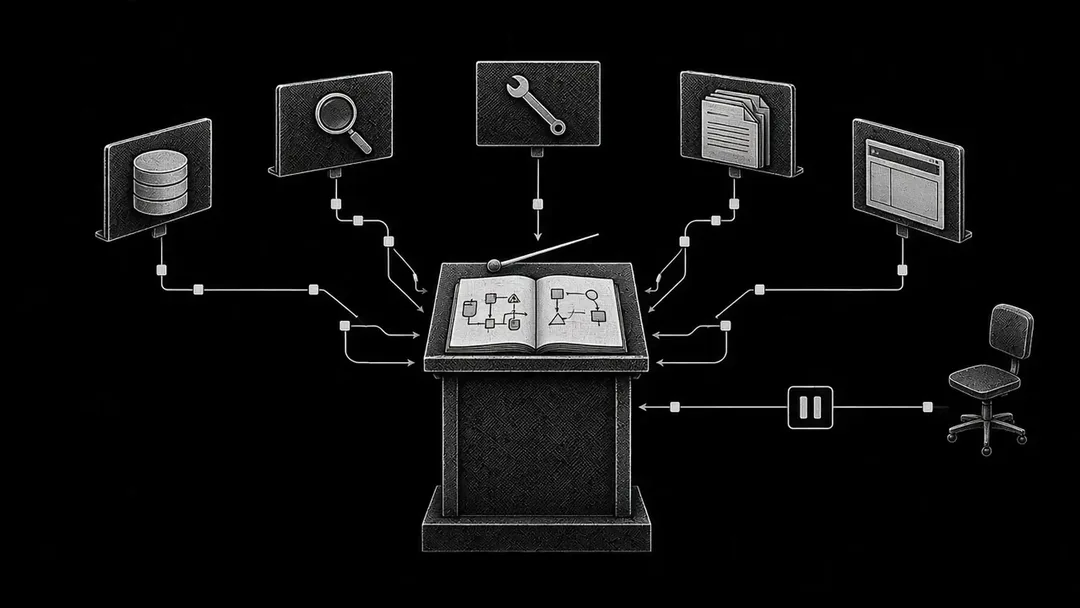
Open the packet before you open the demo.
Page one states the job in one sentence, and lists the failures that stop a release. Page two describes the golden set: how many cases, where they came from, who updates them. Page three lists the metrics that match that job, and how often your graders agree with a person you trust. Page four states the rule for a score that drops, plus a recent sample of production traces.
An LLM evaluation framework is the system that produces this packet on a schedule. Vendor tools can help you run the tests but someone still has to write the job and pick the cases. And someone has to decide what stops a ship.
Most articles ranking for the phrase are catalogues of those tools: DeepEval, LangSmith, a G-Eval wrapper. Useful shelves but the meeting still needs the packet.
A 30-day plan you can put on the calendar
You do not need a perfect platform to start. Hamel Husain's advice in Your AI Product Needs Evals (29 March 2024) is the one worth pinning above the workstream:
Keep it simple. Don't buy fancy LLM tools. Use what you have first.
And:
You are doing it wrong if you aren't looking at lots of data.
He also wrote the line that explains why so many rollouts stall after a clean demo:
I've found that unsuccessful products almost always share a common root cause: a failure to create robust evaluation systems.
A first version over 30 days can look like this.
- Days 1 to 5. Write one page that states the job and the failures that stop a release.
- Days 5 to 12. Pull a starting golden set from real tickets, emails, or logs, and add the ugly edge cases on purpose. Give the set an owner.
- Days 8 to 16. Build code graders for anything a script can check: schema, required citations, forbidden actions, tool arguments, whether a row got written.
- Days 12 to 20. Sit with a domain expert and grade a sample by hand until the criteria stabilize enough to write down. OpenAI's evaluation best practices tell you to "Log everything" so you can mine those logs for new cases, and to use human feedback "to calibrate automated scoring."
- Days 18 to 25. Only then consider an LLM-as-a-judge, and measure it against the human-graded sample before it touches a dashboard.
- Days 22 to 28. Put a regression suite on the same path as a prompt change, a retrieval change, or a model swap. A drop stops the release.
- Days 25 to 30, then every week after. Sample production traces, and add new failures back into the set.
Our earlier post on RAG vs fine-tuning argued for a frozen eval set before you leave a POC. The 30 days above are how that set becomes a packet a review can use.
What an LLM evaluation framework has to include
Use this as the contents page of the packet. Fill every row before you ask for a wider rollout.
Piece | What it is | What "good" looks like to an executive |
|---|---|---|
Named job | A one-sentence description of the work the system must do, plus the failures you will not ship | Anyone in the room can repeat the job and the stop conditions without a slide |
Golden set | A living set of inputs, expected behavior, and hard cases, drawn from real traffic where you can get it | The set looks like production, includes costly edge cases, and has an owner who updates it |
Error taxonomy | A list of the failure modes you actually see, with rough frequency | You can say which errors are common, which are rare and expensive, and which ones you are measuring |
Task metrics | Scores that match the job: groundedness, schema, tone, tool success, refusal quality, latency, cost | You can explain each metric in plain language, without leaning on BLEU or a generic "quality" bar alone |
Graders | Code checks where a rule exists; human review where judgment exists; an LLM-as-a-judge only after you have calibrated it | You know how often the automated score agrees with a person you trust |
Offline gate | A regression suite that runs on every material change | A drop can stop a release. Capability tests can still be a hill to climb |
Online loop | Sampled production traces, fed back into the golden set | Every new failure gets added as a test |
Owner and cadence | A named person, a review rhythm, and a written stop-ship rule | One person answers for the number, and the board gets a written packet with the scores |
Two rows go missing more often than the rest.
The golden set has to look like production. OpenAI warns against eval datasets "that don't faithfully reproduce production traffic patterns," and against "Relying solely on academic metrics like perplexity or BLEU score." Anthropic's guide to defining success criteria and building evaluations is just as direct: "Be task-specific: Design evals that mirror your real-world task distribution." A dozen happy-path prompts from the demo will get you through the demo, but they will not get you through a review.
The owner matters as much as the dashboard. Name who updates the set, who reviews disagreements between the judge and a human, and what happens when the regression suite moves. A dashboard with no one who can stop a ship is decoration.
Husain draws a line that belongs under this table:
This calls for product evals tailored to your users' tasks, which measure something different from general model benchmarks.
Graders that will survive a skeptical reading
Once the set exists, you need a way to score it more than once.
Husain describes three levels that are easy to explain in a review. Level 1 is unit tests: cheap, repeatable checks you can run on every change. Level 2 is model-and-human evaluation, including the messy work of looking at traces. Level 3 is A/B testing in the product. Cost rises as you go up, which should dictate cadence: run the cheap tests constantly, the human-calibrated reviews on a schedule, and the experiments after a real change.
Anthropic's Demystifying evals for AI agents (9 January 2026) uses a similar split in grader types: code-based, model-based, and human. They also separate capability evals from regression evals. Regression evals, they write, "should have a nearly 100% pass rate. They protect against backsliding, as a decline in score signals that something is broken." Capability tests can stay unfinished for a while, with a pass rate you are still climbing. The release suite is the one that has to hold.
Start with code wherever a script can do the work. Judgment-heavy questions (tone, helpfulness, whether a summary missed a material risk) are where teams reach for an LLM-as-a-judge. That can work. It falls over in a serious review if you cannot show agreement with a person.
The well-known Judging LLM-as-a-Judge with MT-Bench and Chatbot Arena paper (Zheng, Chiang, Sheng, Zhuang, Wu, Zhuang, Lin, Li, Li, Xing, Zhang, Gonzalez, and Stoica, 2023) found that strong judges such as GPT-4 can "match both controlled and crowdsourced human preferences well, achieving over 80% agreement, the same level of agreement between humans." The same paper examines "position, verbosity, and self-enhancement biases," plus limited reasoning ability. A judge that prefers the longer answer, or the model from the same family, will look decisive in a dashboard and still be wrong.
Microsoft researchers made a related point in G-Eval (Liu, Iter, Xu, Wang, Xu, and Zhu, EMNLP 2023; also arXiv:2303.16634). G-Eval, using GPT-4 with chain-of-thought and a form-filling setup, reached a Spearman correlation of 0.514 with human ratings on a summarization task, "outperforming all previous methods by a large margin." They also "highlight the potential issue of LLM-based evaluators having a bias towards the LLM-generated texts." A 0.514 correlation is a genuine improvement over BLEU and ROUGE, which they note have "relatively low correlation with human judgments." Treat it as a useful automated signal, and still check it against a human sample before it appears in the packet.
Then there is the question of who watches the watcher. In Who Validates the Validators? (Shankar, Zamfirescu-Pereira, Hartmann, Parameswaran, and Arawjo, UIST 2024), the authors write:
Yet LLM-generated evaluators simply inherit all the problems of the LLMs they evaluate, requiring further human validation.
They also name a pattern that shows up in product reviews:
users need criteria to grade outputs, but grading outputs helps users define criteria.
They call this criteria drift. Your rubric will move as you look at real answers. Write the rubric anyway. Expect to revise it. Keep a human in the loop while you do.
Offline gates and the production flywheel
A notebook of scores will not survive a release train. You want two loops.
The offline loop is a regression suite you run on every material change: a prompt edit, a retrieval change, a model swap, a new tool. If the suite drops, you stop. Anthropic's nearly 100% pass rate is the right instinct for that suite.
The online loop is how the suite stays honest. OpenAI's guidance is to "Set up continuous evaluation (CE) to run evals on every change, monitor your app to identify new cases of nondeterminism, and grow the eval set over time." That only works if you can see what the system actually did. Traces, retrieved documents, tool calls, and grader scores belong in the same place. That is the job of AI observability.
If the product is an agent, the same ownership question shows up in a different costume. Anthropic defines an eval in plain language: "give an AI an input, then apply grading logic to its output to measure success." For agents, they also want you to grade the transcript and the outcome. A fluent "your flight is booked" can still sit next to an empty reservation table. We wrote about unowned tools and missing traces in How to Orchestrate AI Agents Without Spaghetti Graphs.
Groundedness belongs on the scorecard whenever the system is allowed to speak from documents. If you cannot point at a source, you do not have a defensible answer. We walked through practical mitigations in 7 Practical Ways to Prevent LLM Hallucinations and Protect Your Product.
If someone drops a public benchmark into the packet
OpenAI's evaluation guide makes a distinction that belongs on page one of any review. Industry benchmarks, they write, compare "models in isolation." Numerical scores such as ROUGE or BERTScore can be ingredients. The work that matters is "designing your own evals" for your application.
Public benchmarks are useful for comparing models under a shared protocol.
Stanford CRFM's Holistic Evaluation of Language Models (Liang, Bommasani, Lee, and colleagues, 2022/2023) was built because accuracy alone hides the trade-offs a serious buyer should see. They measure seven metrics (accuracy, calibration, robustness, fairness, bias, toxicity, and efficiency) across 16 core scenarios, and they say why:
This ensures metrics beyond accuracy don't fall to the wayside, and that trade-offs are clearly exposed.
They also found that, before HELM, "models on average were evaluated on just 17.9% of the core HELM scenarios," with some prominent models not sharing a single scenario in common. HELM is a living research benchmark, and the project lives at crfm.stanford.edu/helm. Take the reminder: a single score is a thin story, and a product scorecard has to cover the workflow you actually ship.
A support assistant and a contract-review tool can share a base model and still need completely different tests. If the only evidence in the packet is that a base model looks strong on a public leaderboard, the product itself is still untested. The leaderboard never saw your data or your tools.
For a walkthrough of that multi-metric idea from the HELM team, watch -
Questions a skeptical director will ask
If the packet is silent on one of these, the rollout often stalls in the review.
"How do we know this works beyond the answers we liked in the room?"
A few good answers in a meeting make a demo, and a demo gives you no baseline. OpenAI already named the anti-pattern:
Vibe-based evals: Using "it seems like it's working" as an evaluation strategy, or waiting until you ship before implementing any evals.
Husain's case study of a real-estate assistant, Lucy, is the product version of the same stall. Once the surface area grew, "Addressing one failure mode led to the emergence of others, resembling a game of whack-a-mole," and the team had "limited visibility into the AI system's effectiveness across tasks beyond vibe checks."
"Can we just buy an evaluation toolkit and call this done?"
Husain's advice is direct: "Don't rely on generic evaluation frameworks to measure the quality of your AI. Instead, create an evaluation system specific to your problem." A library can run your tests. It cannot tell you what "good" means for your users.
"Why are we not using a public leaderboard as the score?"
HELM is useful for comparing models under a shared protocol. Your board is asking whether this workflow, with this data and these tools, still holds. If you want the leaderboard in the room, park it in an appendix and keep the product scorecard in the packet.
"Can the model grade its own output?"
Yes, after you have a human-graded sample and you have measured agreement. Zheng's 80% figure came from a specific setting and may not hold on your task. G-Eval's 0.514 Spearman correlation is progress over BLEU, and it still leaves plenty of disagreement. Shankar's warning still stands: the judge inherits the model's problems until a person validates it.
"What happens after launch, when the traffic changes?"
Traffic shifts. Prompts drift. A policy changes on a Friday. If production failures never become tests, the suite will keep passing while the product decays. The online loop exists to keep the golden set honest.
"What, exactly, would stop a release?"
If you cannot name the rule, you have a dashboard and no gate. Pick the metrics that match the job. Report them with the human disagreement rate. Write down the drop that holds a release, and the person who is allowed to call it.
Illustrative composite. A product team ran a six-week RAG assistant over a policy corpus. The demo answers cited the right paragraphs. When a director asked how often the system was silent, wrong, or inventing a citation, the team had a notebook of favorite prompts and a model card. They did not have a held-out set, a groundedness score with a human check, or a rule for what would stop a release. The demo went fine, and the project stalled in the review.
FAQ
What is an LLM evaluation framework?
An LLM evaluation framework is the system you use to test whether a language-model product still does the job you claimed: a named objective, a living golden set, task-specific metrics, graders you can run on a schedule, an offline gate that can stop a release, and a loop that turns production failures into new tests. A public model leaderboard or a vendor dashboard alone does not count.
How is an LLM evaluation framework different from a model benchmark?
A model benchmark compares models in isolation, often on public tasks such as those in HELM or MMLU. An LLM evaluation framework tests your application: your prompts, your data, your tools, and your failure modes, on a distribution that looks like production. OpenAI draws this line in its evaluation guidance, and Hamel Husain argues that product evals "measure something different from general model benchmarks."
Can I use an LLM as a judge in the framework?
Yes, after you have a human-graded sample and you have measured how often the judge agrees with it. Research such as Zheng et al. shows strong judges can reach high agreement with humans on some preference tasks, and also documents position, verbosity, and self-enhancement biases. Shankar et al. are direct that LLM-generated evaluators inherit the problems of the models they evaluate and still need human validation.
What should I show a board or an executive review?
Show the job in one sentence, the failures you will not ship, the size and origin of the golden set, the metrics that match the job, the agreement rate between automated graders and a trusted human, the offline stop-ship rule, and how production traces feed the set. A model name and a demo transcript can go in as supporting material at the back.
How do offline and online evaluations work together?
Offline evaluations are the regression and capability tests you run on a frozen set before a change goes out. Online evaluations sample live traffic, including traces and outcomes, to find new failures and distribution shift. OpenAI's continuous-evaluation advice is to run evals on every change and grow the set over time. Run both loops. Each one catches failures the other will miss.
How large does the golden set need to be?
Large enough to cover the job, the costly edge cases, and the failures you have already seen, and small enough that a person can still look at the misses. Start with a carefully reviewed set drawn from real traffic and grow it as production teaches you, rather than beginning with a huge synthetic set nobody has read. Update it on a cadence. A set that never changes will go stale.
Sources
- OpenAI, Evaluation best practices.
- Hamel Husain, Your AI Product Needs Evals, 29 March 2024.
- Percy Liang, Rishi Bommasani, Tony Lee, et al., Holistic Evaluation of Language Models (HELM), arXiv:2211.09110. Project site: crfm.stanford.edu/helm.
- Anthropic, Define success criteria and build evaluations.
- Anthropic, Demystifying evals for AI agents, 9 January 2026.
- Lianmin Zheng et al., Judging LLM-as-a-Judge with MT-Bench and Chatbot Arena, arXiv:2306.05685, 2023.
- Yang Liu, Dan Iter, Yichong Xu, Shuohang Wang, Ruochen Xu, and Chenguang Zhu, G-Eval: NLG Evaluation using GPT-4 with Better Human Alignment, EMNLP 2023. Also arXiv:2303.16634.
- Shreya Shankar, J.D. Zamfirescu-Pereira, Björn Hartmann, Aditya Parameswaran, and Ian Arawjo, Who Validates the Validators?, UIST 2024.
- YouTube, Holistic Evaluation of Language Models (HELM), Yifan Mai, Stanford University.
- YouTube, Why AI evals are the hottest new skill for product builders, Hamel Husain and Shreya Shankar, Lenny's Podcast.
- Roro, RAG vs Fine-Tuning: When to Fine Tune an LLM and When to Retrieve.
- Roro, AI Observability.
- Roro, How to Orchestrate AI Agents Without Spaghetti Graphs.
- Roro, 7 Practical Ways to Prevent LLM Hallucinations and Protect Your Product.