A customer writes in: "We were charged twice for October. Please refund the duplicate."
Generative AI can draft a polite reply to that email in about two seconds. Agentic AI can find the account, pull the October invoices, confirm which charge is the duplicate, issue the credit, and then write the reply. In the first case the model writes about the work. In the second it does the work.
That's the real difference between agentic AI and generative AI. Generative AI produces content when you ask for it. Agentic AI runs a model in a loop, picking tools and reading what they return, until the job is done or a person steps in.
The questions below are the ones a CTO or an ops head tends to ask when deciding what to build. Each answer uses that refund email as the test case.
What does each one actually do with that email?
A generative setup writes the reply and leaves every lookup to a person. An agent goes into the billing system, decides what to check, acts, and then writes.
The plainest generative version is a support inbox wired to a model with a short system prompt:
You are a polite billing assistant for Acme. Draft a reply to the customer email below. Be concise and apologetic.A draft comes back in a second or two. The rep still opens the billing admin, finds the invoice, issues the credit by hand and hits send. It costs one model call per email and saves the typing. Most of the rep's time went into looking things up, so the saving is real and small.
Read the draft closely and you will often find "I've processed your refund." The model has no access to billing. It cannot know whether a duplicate exists, let alone whether anyone refunded it. It wrote that sentence because it is a very likely sentence in a refund email, and that is why every draft needs a human read. Feeding it the customer's recent invoices helps a lot (our post on RAG vs fine-tuning covers that choice), but somebody still has to fetch the right invoices and decide what to do.
The agent version gets a goal instead:
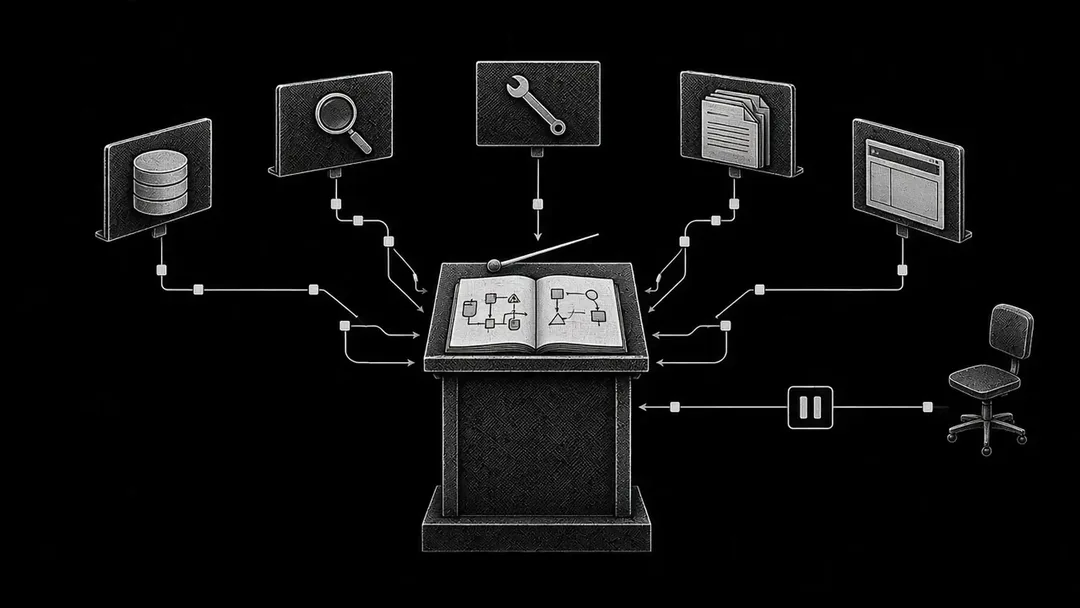
Resolve this billing email according to the refund policy. Ask a human before issuing any credit over $500.It also gets seven tools: search_customers, list_invoices, read_payment_events, read_refund_policy, create_pending_credit, draft_reply and escalate_to_human. Nothing in the code says which to call or in what order. One run might look like this:
1  search_customers("ops@northwind.example")   -> 2 matches: "Northwind", "Northwind Ltd"
2  read_payment_events(both accounts, Oct)     -> Northwind Ltd: charge failed, retried 6h later
3  list_invoices("Northwind Ltd", Oct)         -> 2 paid invoices, $240 each, same plan
4  read_refund_policy()                        -> duplicates refundable within 60 days
5  create_pending_credit($240, inv #2)         -> pending, under $500 limit
6  draft_reply(...)                            -> explains which charge is reversed
The model spotted two accounts with similar names and worked out that one charge was a retry after a card decline. On the next email it might take four steps, or fourteen. OpenAI's practical guide to building agents describes this behavior when it says an agent "recognizes when a workflow is complete and can proactively correct its actions if needed."
Is agentic AI just generative AI with extra steps?
Mostly, yes, and we think that is the most useful way to see it. Nearly every agent today is a generative model wrapped in a loop with tools and memory. The extra steps are where all the new cost and risk come from.
Vendors file it differently. Google Cloud calls agentic AI "a subset of generative AI that is centered around the orchestration and execution of agents that use LLMs as a 'brain' to perform actions through tools." IBM's explainer on agentic AI vs generative AI describes it as building on generative capabilities and frames the change from the user's seat: with agentic AI you can "provide a broader objective rather than specifying every step." The taxonomy argument matters less than the plumbing, and the plumbing is the same in every version.
That loop is older than the hype. The ReAct paper (Yao et al., October 2022) had models produce reasoning and actions "in an interleaved manner," where "actions allow it to interface with external sources, such as knowledge bases or environments, to gather additional information." A few months later, Toolformer (Schick et al., February 2023) showed language models "can teach themselves to use external tools via simple APIs."
If you need to send one thing to a non-technical stakeholder, send Martin Keen's seven-minute IBM Technology video above. He describes generative systems as "fundamentally reactive" and agentic systems as running a perceive, decide, act and learn cycle "with minimal human intervention."
Agentic AI vs generative AI: what changes in cost, latency, risk and testing?
Nearly everything operational changes, because control of the next step moves from a person or your code to the model. The table puts the refund email through three approaches, including the fixed workflow covered in the next section.
Generative AI | Workflow | Agent | |
|---|---|---|---|
Who decides the next step | The human | Your code | The model |
What it produces | Text | Text plus fixed actions | Actions plus text |
Touches the billing system | Only when a human does | Through calls you wrote | Through tools it picks |
Model calls per email | One | Two | Varies, often many |
Cost per email | Lowest, predictable | Low, predictable | Highest, varies |
Latency | Seconds | Seconds | Seconds to minutes |
Typical failure | Invents a fact | Sends an edge case to a person | Takes a wrong action and builds on it |
How you test it | Grade outputs | Unit-test steps and grade outputs | Grade whole runs in a sandbox first |
On cost, Anthropic reported in How we built our multi-agent research system (June 2025) that "agents typically use about 4× more tokens than chat interactions, and multi-agent systems use about 15× more tokens than chats." Because the step count varies per ticket, so does the bill per ticket. Finance will ask you for a monthly forecast, and you will have a range.
Risk is the row we would spend the most time on. Look at step 1 of the trace again. Had the model picked "Northwind" instead of "Northwind Ltd," every later step would have reasoned confidently from the wrong account, and the $240 credit would have landed on a customer who was never double charged. Anthropic's Building effective agents names it directly: "the autonomous nature of agents means higher costs, and the potential for compounding errors." Its advice is "extensive testing in sandboxed environments, along with the appropriate guardrails."
A generative model can say something false. An agent can do something you did not want. The first is handled well by a human reviewer and an evaluation set. The second needs permissions scoped per tool and an approval gate on anything irreversible. It also needs a trace of every step, so you can reconstruct a run afterwards. That trace is what we mean by AI observability, and teams skip it more often than any other piece.
Testing changes too. With an agent you are grading a path. Two runs can reach the same correct credit through different tool calls, and one of them may have read an account it had no business reading. Our LLM evaluation framework post covers how to set that up.
If code controls the steps, is it still an agent?
By Anthropic's definition, no. It is a workflow. Anthropic groups both under "agentic systems" and then splits them:
"Workflows are systems where LLMs and tools are orchestrated through predefined code paths."
"Agents, on the other hand, are systems where LLMs dynamically direct their own processes and tool usage, maintaining control over how they accomplish tasks."
Here is the refund email as a workflow. Code does the lookups and the model only touches language:
intent = llm.classify(email, labels=["duplicate_charge", "failed_card",
                                      "plan_change", "other"])
if intent.label != "duplicate_charge":
    return human_queue.add(email)

invoices = billing_api.list_invoices(intent.account_email, intent.month)
dupes = find_duplicates(invoices, same_amount=True, same_plan=True,
                        within_hours=48)
if not dupes:
    return human_queue.add(email, note="no duplicate found")

credit = billing_api.create_pending_credit(dupes[1])   # a human approves
reply = llm.draft_reply(email, invoices=dupes, credit=credit)
That is two model calls plus two API calls, and the duplicate rule is something a finance person can read. Anthropic would call this a mix of the patterns it names "routing" and "prompt chaining." Every decision about what happens next lives in code your team can unit-test.
It breaks on cases the rule never imagined, like a double charge across a plan upgrade or a duplicate that was already partly refunded. The Northwind email would land here too. All of them go to the human queue, which is the designed failure, and it is cheap. Most of the engineering cost sits in writing billing_api, and on an old .NET system that integration is usually where the real work goes.
OpenAI draws the same boundary from the other side: "Applications that integrate LLMs but don't use them to control workflow execution ... are not agents." We think the workflow/agent split is the most useful one in the field, because it maps to a decision you actually make in code. Our honest guess is that a large share of projects pitched as "agentic AI" are best served by a workflow.
Why do agent demos look so much better than production?
Demos usually run on tasks with a built-in answer key, and most business tasks lack one.
Andrew Ng made the case for agentic workflows in a March 2024 letter in The Batch, using a coding benchmark: "GPT-3.5 (zero shot) was 48.1% correct. GPT-4 (zero shot) does better at 67.0%." Then the line everyone quoted: "wrapped in an agent loop, GPT-3.5 achieves up to 95.1%."
The result is real. Read the benchmark before borrowing the conclusion, though. The tasks are code with automated tests, so the agent gets a pass or fail on every attempt. Anthropic picks coding as a strong fit for the same reason: "code solutions are verifiable through automated tests," so agents "can iterate on solutions using test results as feedback."
Our refund email sits closer to coding than you might expect. A credit either matches the invoice data or it does not, and you can check it. A marketing brief with no clear success test is a much weaker candidate for an agent loop, however good the demo looked.
In Anthropic's eighteen-minute video above, Barry Zhang and Erik from its applied AI and research teams talk with Alex Albert about where workflows end and agents begin. Worth it for anyone about to approve an agent budget.
How many companies actually run agents, and why do so many projects get canceled?
About a quarter of companies in McKinsey's latest survey say they are scaling an agent somewhere, and Gartner expects a big share of agentic projects to be dropped.
McKinsey's State of AI 2025 survey (fielded June and July 2025, 1,993 respondents) found 23 percent saying their organizations are "scaling an agentic AI system somewhere in their enterprises," and "an additional 39 percent say they have begun experimenting with AI agents." Most of the ones scaling do it in only one or two functions.
Gartner's June 2025 forecast predicts "over 40% of agentic AI projects will be canceled by the end of 2027," with escalating costs and unclear business value at the top of its reasons. Analyst Anushree Verma added: "Many use cases positioned as agentic today don't require agentic implementations." The release also named something buyers keep running into, "agent washing," which Gartner describes as "the rebranding of existing products ... without substantial agentic capabilities," with RPA and chatbots among the usual suspects. Its estimate is that "only about 130 of the thousands of agentic AI vendors are real."
When a vendor says "agentic," ask who decides the next step in their product. If the answer is a fixed script with a model writing the text, you are buying generative AI or a workflow. That may be exactly what you need. Pay workflow prices for it.
AI agents vs agentic AI: are they the same thing?
Close, and people use them loosely. The common reading treats an AI agent as one unit and agentic AI as the broader property or a larger system.
In that reading, an AI agent is one model with tools and instructions doing one kind of job. The refund agent above is an AI agent. Agentic AI may coordinate several of them. Google Cloud calls AI agents "the building blocks of agentic AI." A May 2025 review, AI Agents vs. Agentic AI: A Conceptual Taxonomy, Applications and Challenges by Sapkota, Roumeliotis and Karkee, draws a similar line and characterizes agentic AI by "multi-agent collaboration, dynamic task decomposition, persistent memory, and coordinated autonomy."
Anthropic flips the words around, with "agentic systems" as the umbrella and "agent" as the specific design where the model directs its own process. We use Anthropic's version when building. Whichever your team picks, write it down where everyone will see it. Simon Willison put the problem well in his review of 2024: "If you tell me that you are building 'agents', you've conveyed almost no information to me at all."
If you are heading toward several agents working together, our post on orchestrating AI agents without spaghetti graphs covers how to supervise them and where the human checkpoints go.
Does agentic AI replace traditional automation?
Rarely. It takes the exceptions that rules handle badly and leaves the predictable cases to the rules.
The 48-hour duplicate rule in the workflow sketch is traditional automation. A rule like that is cheap to run and easy to audit, right up until the inputs drift from what its author expected.
OpenAI's guide uses fraud analysis to show the difference: "A traditional rules engine works like a checklist, flagging transactions based on preset criteria," while an LLM agent "functions more like a seasoned investigator, evaluating context, considering subtle patterns." It points agents at work that calls for "nuanced judgment" and at rule sets that have grown "unwieldy." Then comes the caveat we wish more vendors quoted: "Before committing to building an agent, validate that your use case can meet these criteria clearly. Otherwise, a deterministic solution may suffice."
For the refund emails, the agent earns its keep only if Northwind-style cases are common enough to pay for the extra tokens and testing. If they are rare, let them go to a person.
Which one should I use for my task?
Pick the least autonomous option that does the job, and decide per task. A whole department almost never fits a single answer.
Start with who reads the output. If a person reviews it before it goes anywhere, use generative AI and stop there, adding retrieval if facts matter. Drafting, summarizing, translating, first-pass code and research notes all live here. A good prompt plus a vector store in Postgres for your own documents covers a surprising amount of ground.
Next, try to write the steps down. If a competent new hire could follow a flowchart for 90 percent of cases, build the flowchart as a workflow and route the rest to a person. You keep most of the value at a fraction of the cost, and your auditors will understand it.
Consider an agent only when the number and order of steps change case by case and you can measure whether the outcome was right. Start it in a sandbox with read-only tools. Add write tools one at a time, each behind an approval gate.
Whatever you build, work out the worst thing it could do. A bad draft is low risk. Anything that moves money or emails a customer needs a human approval on that tool, and you should be able to reconstruct every step of a run from logs before you grant write access.
Tracing comes before autonomy.
If you want to test the idea before writing code, a no-code AI agent builder can get a prototype running in an afternoon, as long as you plan for outgrowing the canvas. Most agents that fail in production fail for operational reasons, such as broad permissions or nobody watching the traces. We wrote those patterns up in why AI agents keep failing in production.
Where does Roro fit?
Roro builds AI into existing products, often on older stacks (.NET, PHP, Java and the like) that were never designed with a language model in mind. Most of that work is the unglamorous middle layer: the API, permissions, evaluation sets and tracing that let anyone trust an agent later. Upgrade your stack explains how we add AI to an existing system, and AI observability covers how we keep it visible once it is live.
FAQ
What is the difference between generative AI and agentic AI?
Generative AI creates content such as text, images, audio or code in response to a prompt, and then waits for the next instruction. Agentic AI uses a generative model inside a loop that pursues a goal: it plans steps, calls tools and other systems, reads the results and decides what to do next until the task is done or it hands back to a human. In short, generative AI produces outputs and agentic AI takes actions toward an outcome.
Is ChatGPT generative AI or agentic AI?
ChatGPT started as a generative AI product: you prompt it and it writes a response. It has since gained agentic features. ChatGPT agent, which OpenAI launched in July 2025, can use its own virtual computer to browse websites and run code while it completes multi-step tasks, and it asks for permission before actions of consequence.
Is agentic AI a type of generative AI?
Some vendors classify it that way. Google Cloud calls agentic AI a subset of generative AI that uses LLMs as a "brain" to act through tools, while IBM describes it as building on generative capabilities. In practice, nearly every agentic system today uses a generative model for reasoning and language, then wraps it in a control loop that has access to tools and memory.
What is the difference between AI agents and agentic AI?
An AI agent is usually a single system with a model, tools and instructions that carries out one type of task. Agentic AI is the broader term for systems that act with some autonomy, which can include several agents coordinating on a larger goal. Anthropic uses the words differently, with "agentic systems" as the umbrella and "agents" as designs where the model directs its own steps, so it helps to agree on definitions within your team.
When should a business use an AI agent instead of generative AI?
Use an agent when a task needs several steps whose order depends on what the system discovers and the outcome can be checked against a clear success test. You should also be able to give the agent narrowly scoped tools, with approval gates on risky actions. If a person will review the output anyway, or the steps fit a fixed flowchart, generative AI or a fixed workflow is cheaper and easier to govern.
Why do agentic AI projects fail?
Gartner predicts over 40% of agentic AI projects will be canceled by the end of 2027, and the reasons it gives include escalating costs and unclear business value. Common causes in practice are using an agent where a fixed workflow would do, running without an evaluation set, granting broad permissions and keeping no traces of what the agent did.
Sources
- OpenAI, A practical guide to building agents (PDF).
- Erik S. and Barry Zhang, Building effective agents, Anthropic, 19 December 2024.
- Anthropic, How we built our multi-agent research system, 13 June 2025.
- IBM, Agentic AI vs. Generative AI.
- Google Cloud, What is agentic AI? Definition and differentiators.
- Shunyu Yao et al., ReAct: Synergizing Reasoning and Acting in Language Models, arXiv, October 2022.
- Timo Schick et al., Toolformer: Language Models Can Teach Themselves to Use Tools, arXiv, February 2023.
- Andrew Ng, Agentic Design Patterns Part 1, The Batch, 20 March 2024.
- Gartner, Gartner Predicts Over 40% of Agentic AI Projects Will Be Canceled by End of 2027, 25 June 2025.
- McKinsey, The state of AI in 2025: Agents, innovation, and transformation, 5 November 2025.
- Ranjan Sapkota, Konstantinos I. Roumeliotis and Manoj Karkee, AI Agents vs. Agentic AI: A Conceptual Taxonomy, Applications and Challenges, arXiv, May 2025.
- OpenAI, Introducing ChatGPT agent, 17 July 2025.
- YouTube, Generative vs Agentic AI: Shaping the Future of AI Collaboration, IBM Technology.
- YouTube, Tips for building AI agents, Anthropic.